Structural Drying & Dehumidification in Huntersville, NC
A dry-looking floor can still hold water in the framing, subfloor and wall cavities. The drying team dries the structure, not just the surface, and proves it with readings.
(888) 578-4720Have the drying team measure the structure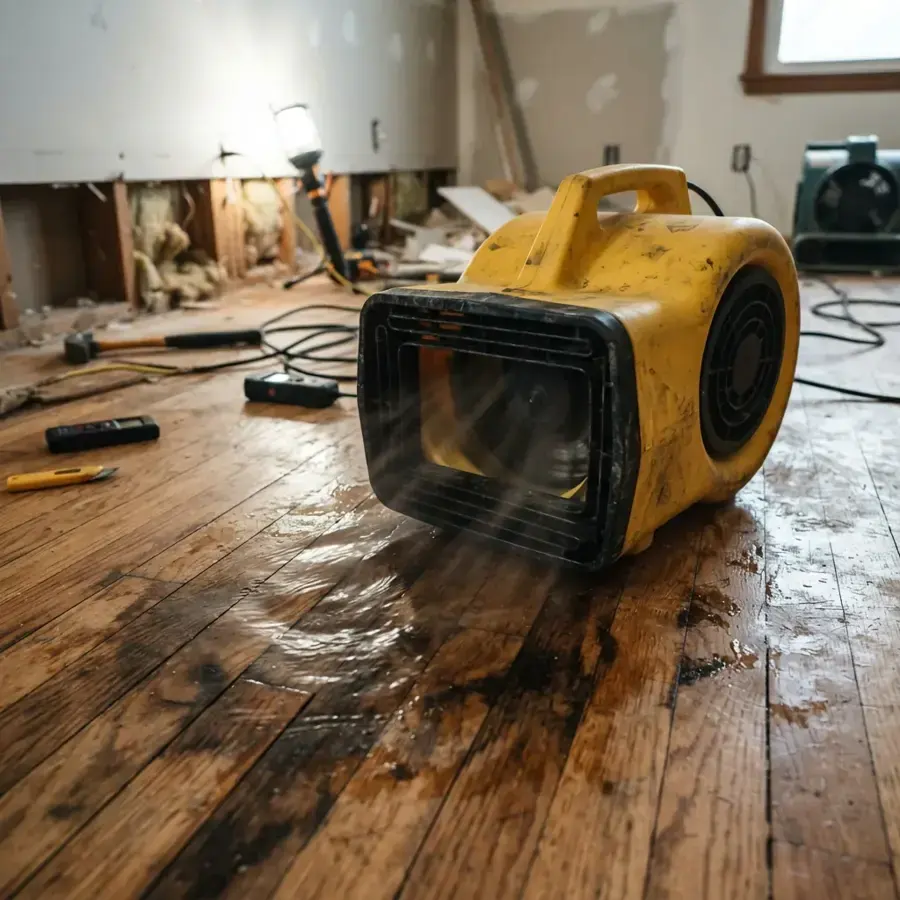
What to do the moment you find structural drying
- Remove standing water first
Drying equipment cannot keep up while water is still on the floor.
- Close windows in humid weather
Outdoor Carolina air in summer adds moisture back in.
- Leave the equipment running
Turning air movers and dehumidifiers off at night stalls the drying.
- Call for readings
Call (888) 578-4720 to have the structure measured against a dry reference.
How structural drying is handled in Huntersville
Moisture mapping first
The tech who does the walkthrough maps wet materials with pinless meters and thermal imaging before any equipment goes down.
Extraction before drying
The extraction crew pulls standing water out of the building first, because every gallon left behind adds days of drying.
Equipment sized to the room
Air movers and LGR dehumidifiers go in at the evaporation load of each room, set by the IICRC S500 class of the loss.
Readings decide the finish
The drying team records readings daily and pulls equipment only when wet materials sit within 2 to 4 points of a dry reference.
What does structural drying and dehumidification cost in Huntersville, NC?
In Huntersville, NC, structural drying typically runs $1,000 to $6,000, depending on the class of the loss, the number of rooms, the materials involved (hardwood and concrete take longer) and how many days the equipment runs.
Several air movers, one LGR, three to four days
$1,000 to $2,500More equipment, wall cavity drying, daily logs
$2,500 to $4,500Desiccant units, drying mats, longer monitoring
$4,500 to $6,000+Every loss is priced on its own scope. Run the numbers in the water damage cost calculator for a planning range.
The structural drying and dehumidification process, start to dry
- 1
Moisture map and class
The tech maps wet materials and sets the IICRC S500 class of the loss.
- 2
Equipment placement
Air movers, LGR dehumidifiers and, for dense materials, desiccant units go in.
- 3
Daily monitoring
The drying team logs psychrometric and material readings and adjusts equipment.
- 4
Dry verification
Equipment comes out when readings reach 2 to 4 points of the dry reference.
Structural drying is the part of a water loss nobody sees and everyone pays for if it is skipped. Drywall dries on the surface in a day or two, but studs, bottom plates, subfloor and hardwood hold water much longer. In Huntersville's humid summers the indoor air is already loaded with moisture, so drying a house properly means controlling the air, not just blowing fans at it.
How the IICRC S500 approach works
- Moisture mapping before any equipment goes down, so the plan matches what is actually wet
- Class 1 through 4 sets how much equipment a room needs, based on how much wet material and how porous it is
- Air movers set to the evaporation load of each room
- LGR dehumidifiers for most losses, desiccant units for dense Class 4 materials like hardwood and concrete
The drying goal
Equipment leaves on readings, not on a schedule. The drying team takes readings from a dry reference material in an unaffected part of the same house, then measures the wet materials daily. The goal is reached when the wet materials sit within 2 to 4 points of that dry reference. A contained Class 1 or 2 loss usually gets there in three to five days; hardwood, plaster, concrete and long-running leaks take longer.
Equipment pulled out while the walls still feel damp? Call (888) 578-4720 and the drying team can take readings and check the goal.
Why logs matter for the claim
Daily psychrometric readings (temperature, relative humidity and grains per pound) and material readings make up the drying log. Adjusters use it to see that the equipment count and the days on site matched the loss. The EPA covers indoor humidity at epa.gov, and the USGS explains how water moves through materials at usgs.gov. Try the drying-time estimator for a planning range.
Structural Drying and Dehumidification across Huntersville, NC
The water damage restoration experts cover all of Huntersville in ZIP codes 28078 and 28070, including Birkdale Village, Northstone, Skybrook, Vermillion, Wynfield, Rosedale, Monteith Park and the Gilead Road corridor, with Cornelius, Davidson and the Mountain Island Lake shore as nearby areas.
Related water damage services in Huntersville
Structural Drying and Dehumidification questions, answered
What is the IICRC S500?
It is the industry standard for professional water damage restoration, covering how water losses are inspected, classified, extracted, dried and documented.
What do Class 1 through 4 mean?
The class describes how much water and how much evaporation load a room has: Class 1 is a small area with low-porosity materials, Class 4 involves dense materials like hardwood, plaster or concrete that need specialty drying.
Why not just use fans from the store?
Box fans move air but do not remove moisture. Without dehumidification, the water just moves from the walls into the air and back into other materials.
How is dry measured?
Crews compare wet materials with the same material in a dry part of the house. When the wet readings sit within 2 to 4 points of the dry reference, the goal is met.
Can hardwood floors be dried?
Often, using drying mats and desiccant dehumidification that pull moisture up through the boards. Boards that stay cupped or crowned after drying may need refinishing or replacement.
How long does structural drying take?
A contained Class 1 or 2 loss usually takes three to five days. Hardwood, plaster and concrete can take longer.
Structural Drying and Dehumidification in Huntersville? Call now.
Standing water keeps wicking into drywall, subfloor and crawl space framing until it is pulled out. The Huntersville restoration crew extracts it, dries the structure to the IICRC S500 standard and records every reading for the claim.
(888) 578-4720Get a north Mecklenburg drying crew movingHuntersville Water Damage Restoration
Huntersville, NC · ZIP 28078 and 28070
Dispatch open every hour, every day of the year
Find us on Google