Storm & Creek Flood Cleanup in Huntersville, NC
When tropical-storm rain stalls over north Mecklenburg, creeks rise and clay yards send runoff into homes. The flood cleanup crew treats that water as Category 3 from the first minute.
(888) 578-4720Storm water inside? Talk to dispatch now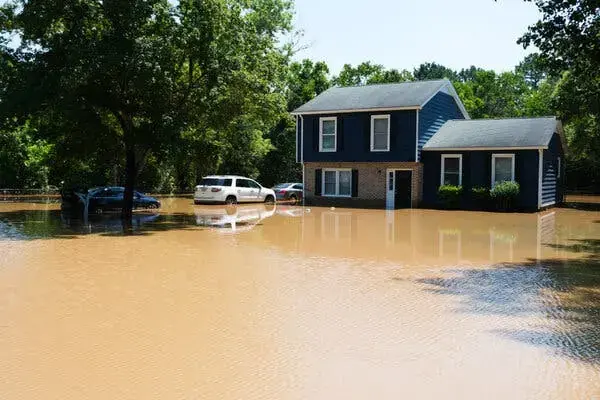
What to do the moment you find storm flooding
- Stay out of floodwater
Do not wade through water near outlets, appliances or a basement panel.
- Kill power if dry to reach
Switch off wet circuits only if you can reach the panel without standing in water.
- Photograph the water line
Capture the height of the water on walls and furniture before it recedes.
- Call for flood cleanup
Call (888) 578-4720 so the crew can extract and start removal.
How storm flooding is handled in Huntersville
Moisture mapping first
The tech who does the walkthrough maps wet materials with pinless meters and thermal imaging before any equipment goes down.
Extraction before drying
The extraction crew pulls standing water out of the building first, because every gallon left behind adds days of drying.
Equipment sized to the room
Air movers and LGR dehumidifiers go in at the evaporation load of each room, set by the IICRC S500 class of the loss.
Readings decide the finish
The drying team records readings daily and pulls equipment only when wet materials sit within 2 to 4 points of a dry reference.
What does storm and creek flood cleanup cost in Huntersville, NC?
In Huntersville, NC, storm and creek flood cleanup typically runs $3,000 to $20,000 or more, because Category 3 water means removal of porous materials, containment and antimicrobial treatment, and the cost scales with square footage and water height.
Shallow runoff, limited drywall, slab drying
$3,000 to $6,000Flood cuts, carpet and pad removal, containment
$6,000 to $12,000Wide removal, antimicrobial, extended structural drying
$12,000 to $20,000+Every loss is priced on its own scope. Run the numbers in the water damage cost calculator for a planning range.
The storm and creek flood cleanup process, start to dry
- 1
Safety and category
The tech confirms power is off in wet areas and documents the loss as Category 3.
- 2
Extraction and removal
The extraction crew pulls water and silt, then removes soaked carpet, pad and drywall.
- 3
Clean and treat
Hard surfaces are cleaned and an EPA-registered antimicrobial is applied under containment.
- 4
Dry to the goal
Air movers and dehumidifiers run until framing and slab readings reach the drying goal.
Huntersville sits between Lake Norman and Mountain Island Lake, with McDowell Creek, Torrence Creek, Clarke Creek and Gar Creek draining the town. Most days they are quiet. When the remnants of a tropical system park over the Charlotte region, as Florence did in 2018 and Helene did in 2024, rain falls for hours on clay that cannot absorb it, and runoff finds garages, lower levels and crawl spaces.
Why floodwater is handled differently
Water that crosses a yard or comes out of a creek carries soil, fertilizer, animal waste and often sewage from overwhelmed systems. Under the IICRC S500 standard that is Category 3 water, and it changes the job:
- Porous materials it touched, such as carpet, pad, drywall and insulation, are removed rather than dried
- Work areas get containment, and HEPA air scrubbers run while materials come out
- Hard surfaces are cleaned and treated with an EPA-registered antimicrobial at its labeled dwell time
- Crews wear gloves, boots and respiratory protection throughout
Flood cut, then dry
After extraction, the mitigation team cuts drywall a set height above the water mark, the flood cut, so wet insulation and the bottom plate can be reached. Then air movers and dehumidifiers dry the studs, slab and subfloor to the drying goal. Dry framing is what lets rebuild start without trapping moisture behind new walls.
Storm water inside? Stay out of water near outlets and appliances, photograph the water line, then call (888) 578-4720 for 24/7 flood cleanup.
Flood insurance and the claim file
Rising surface water is generally a flood claim, not a standard homeowners claim, and most Huntersville homes outside a mapped floodplain do not carry flood coverage by default. Mecklenburg County maps creek floodplains, and FEMA flood maps are explained at fema.gov/flood-maps. The National Weather Service covers flood safety at weather.gov. Either way, the claim file needs the moisture map, daily readings and timestamped photos taken before any demolition.
Storm and Creek Flood Cleanup across Huntersville, NC
The water damage restoration experts cover all of Huntersville in ZIP codes 28078 and 28070, including Birkdale Village, Northstone, Skybrook, Vermillion, Wynfield, Rosedale, Monteith Park and the Gilead Road corridor, with Cornelius, Davidson and the Mountain Island Lake shore as nearby areas.
Related water damage services in Huntersville
Storm and Creek Flood Cleanup questions, answered
Can floodwater-soaked carpet be cleaned?
No. Carpet and pad touched by storm or creek water are Category 3 and are removed and disposed of. Cleaning cannot reliably remove the bacteria and silt that flood water carries.
How high is a flood cut?
Drywall is usually cut a set distance above the highest wet reading, often two to four feet, so wet insulation and the bottom plate can be dried. The exact height comes from the moisture map, not the visible stain.
Is storm flooding covered by homeowners insurance?
Rising surface water is usually excluded from standard homeowners policies and covered only by flood insurance. Wind-driven rain through a damaged roof can be different. Coverage depends on your policy, so it is worth checking with your own insurer.
How long does flood cleanup take?
Extraction and removal often take a day or two, and drying usually runs three to five days after that for framing and slab. Rebuild is a separate phase that starts once the structure is dry.
Which parts of Huntersville flood most?
Lots along McDowell, Torrence, Clarke and Gar Creeks, low spots at the bottom of sloped streets and homes with lower levels facing a hillside collect the most water in heavy storms.
Should I run fans myself after a flood?
Not before the contaminated materials come out. Blowing air over Category 3 water and wet drywall can spread contamination. Extraction and removal come first, then controlled drying.
Storm and Creek Flood Cleanup in Huntersville? Call now.
Standing water keeps wicking into drywall, subfloor and crawl space framing until it is pulled out. The Huntersville restoration crew extracts it, dries the structure to the IICRC S500 standard and records every reading for the claim.
(888) 578-4720Get a north Mecklenburg drying crew movingHuntersville Water Damage Restoration
Huntersville, NC · ZIP 28078 and 28070
Dispatch open every hour, every day of the year
Find us on Google