Basement Flooding Cleanup in Huntersville, NC
Walk-out lower levels on sloped lake and creek lots take water from the hillside, a failed sump or a plumbing leak. The extraction crew clears the floor and the drying team dries the walls behind it.
(888) 578-4720Get the lower level pumped out and drying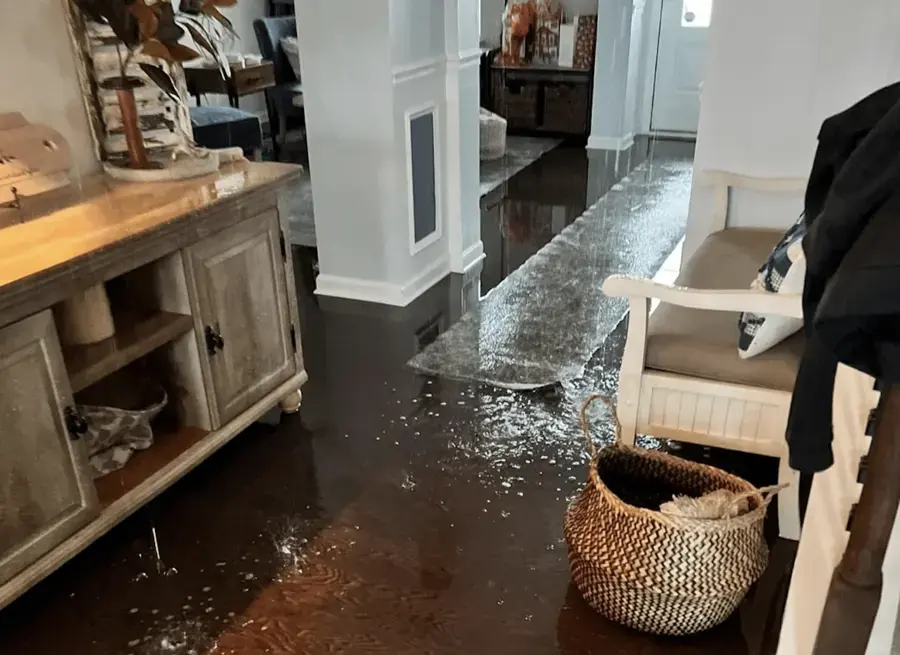
What to do the moment you find a flooded basement
- Stay off a wet floor near outlets
Floor-level outlets and power strips are the hazard in a lower level.
- Stop the source if you can
Close the house shut-off for a plumbing leak, or check whether the sump pump is running.
- Move belongings upstairs
Lift boxes, rugs and electronics off the floor and photograph them first.
- Call for extraction
Call (888) 578-4720 so the crew can pump out the space and set drying.
How a flooded basement is handled in Huntersville
Moisture mapping first
The tech who does the walkthrough maps wet materials with pinless meters and thermal imaging before any equipment goes down.
Extraction before drying
The extraction crew pulls standing water out of the building first, because every gallon left behind adds days of drying.
Equipment sized to the room
Air movers and LGR dehumidifiers go in at the evaporation load of each room, set by the IICRC S500 class of the loss.
Readings decide the finish
The drying team records readings daily and pulls equipment only when wet materials sit within 2 to 4 points of a dry reference.
What does basement flooding cleanup cost in Huntersville, NC?
In Huntersville, NC, basement flooding cleanup typically runs $2,000 to $12,000, depending on whether the water was clean or from outside, how much finished space it reached and how much carpet, drywall and flooring has to come out.
Pump-out, slab drying, limited materials
$2,000 to $4,000Carpet dried in place, pad replaced, wall bases dried
$4,000 to $8,000Category 3 removal, flood cuts, antimicrobial
$8,000 to $12,000+Every loss is priced on its own scope. Run the numbers in the water damage cost calculator for a planning range.
The basement flooding cleanup process, start to dry
- 1
Source and category
The tech identifies the source and the water category, then maps moisture into walls and slab.
- 2
Pump-out and extraction
Submersible pumps handle deep water, then extraction tools clear carpet and corners.
- 3
Remove what cannot dry
Pad, soaked drywall and trapped flooring come out based on the category and the readings.
- 4
Dry and verify
LGR dehumidifiers and air movers run until slab and wall readings reach the goal.
Full basements are less common in Huntersville than crawl spaces, but plenty of homes on sloped lots near Lake Norman, Mountain Island Lake and the creek valleys have finished walk-out lower levels: a family room, a guest suite or a home office set partly into the hill. Water reaches them three ways: through the uphill wall when red clay stays saturated after storms, from a sump pump that stops, and from plumbing in the floor above.
Category decides what stays and what goes
- Category 1 clean water from a supply leak: carpet is usually extracted and dried in place, pad replaced
- Category 2 gray water from an appliance or seepage: more materials are cleaned or pulled
- Category 3 water from outside or a sewer: soaked carpet, pad and lower drywall are removed
- Luxury vinyl plank traps water underneath and is often lifted so the slab can dry
Drying a below-grade room
Concrete walls and slabs hold moisture longer than framed rooms, and a below-grade space stays cool, which slows evaporation. The drying team uses LGR dehumidifiers sized to the space, air movers aimed at wall bases and, when needed, small inspection holes behind baseboards to vent the wall cavity. Readings on the slab and the bottom plates go in the log daily until they reach the drying goal.
Water across the lower level? Keep clear of outlets near the floor, move what you can up the stairs, then call (888) 578-4720 to start extraction.
Finding the source on a hillside lot
When water shows up along the uphill wall after rain, the cause is outside: grading, gutters, a clogged footing drain or hydrostatic pressure from saturated clay. When it shows up near a bathroom or laundry, it is plumbing. The tech who does the walkthrough notes which it is, because the source affects the category, the claim and what keeps it from happening again. The National Weather Service explains how heavy rain events build at weather.gov/gsp, and Ready.gov covers flood safety at ready.gov/floods.
Basement Flooding Cleanup across Huntersville, NC
The water damage restoration experts cover all of Huntersville in ZIP codes 28078 and 28070, including Birkdale Village, Northstone, Skybrook, Vermillion, Wynfield, Rosedale, Monteith Park and the Gilead Road corridor, with Cornelius, Davidson and the Mountain Island Lake shore as nearby areas.
Related water damage services in Huntersville
Basement Flooding Cleanup questions, answered
Why does water come through the uphill wall after storms?
Red clay holds water against the foundation, and on a sloped lot the uphill wall carries that pressure. Water finds cracks, the wall-to-slab joint and window wells. Grading, gutters and footing drains are the long-term fixes once the room is dry.
Can a finished basement be saved after flooding?
Usually much of it can when the water is clean and extraction starts quickly. Framing and drywall above the wet line are dried in place. Category 3 water changes that: porous materials it touched are removed.
Does luxury vinyl plank have to come up?
Often it does. LVP is waterproof on top, but water runs underneath and sits on the slab or subfloor where air cannot reach it. Lifting it lets the slab dry and prevents odor later.
Is basement flooding covered by insurance?
A burst pipe or appliance leak is often covered, while groundwater seepage and surface water usually are not unless there is flood coverage or a specific endorsement. Coverage depends on your policy, so it is worth checking with your own insurer.
How long does a basement take to dry?
A contained Class 1 or 2 loss often dries in three to five days. Concrete walls, a deep slab or a long-running leak can take longer because masonry releases moisture slowly.
What is a flood cut?
A flood cut is a straight cut along the drywall a set height above the wet readings, so the wet section and insulation come out and the studs and bottom plate can dry.
Basement Flooding Cleanup in Huntersville? Call now.
Standing water keeps wicking into drywall, subfloor and crawl space framing until it is pulled out. The Huntersville restoration crew extracts it, dries the structure to the IICRC S500 standard and records every reading for the claim.
(888) 578-4720Get a north Mecklenburg drying crew movingHuntersville Water Damage Restoration
Huntersville, NC · ZIP 28078 and 28070
Dispatch open every hour, every day of the year
Find us on Google