Water Extraction in Mount Holly, NC
Tropical rain can push Mountain Island Lake beyond its 100-foot maximum, as Helene did, and lakeside Mount Holly homes can hold standing water. Pumping comes first, then the drying crew takes over.
(888) 578-4720Water on the floor? Get it pulled out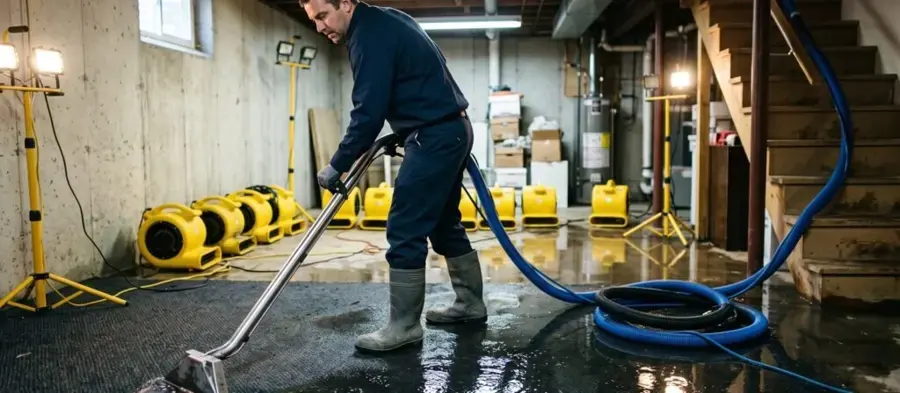
What to do the moment you find standing water
- Stop the supply
Shut the fixture valve or the main so nothing more enters the room.
- Watch the outlets
Stay clear of cords and low outlets, and cut wet circuits only if the panel is dry.
- Capture the damage
Photograph the high-water mark wide and close before moving anything.
- Ask for pumping
Get the extraction crew started on removing the standing water.
How standing water is handled in Mount Holly
Deepest water first
The extraction crew starts at the lowest, wettest spot, so the rest of the structure is not soaking while a pump works elsewhere.
Weighted tools for seams
Rolling weight forces water out of padding and tight corners that suction alone leaves damp.
Hard surfaces dry fast
Tile, sealed concrete and vinyl give up water quickly once the pool is gone, so the equipment plan stays small.
A clean hand-off
When the wand runs dry, the mitigation team measures what remains and the drying team sets the equipment.
What does water extraction and removal cost in Mount Holly, NC?
Extraction by itself in Mount Holly, NC usually costs $300 to $2,500. Paired with the drying that follows, most jobs total $1,200 to $6,000, shaped by the water category, the wet floor area and how long the water stood.
One failed hose or fixture, carpet extracted and kept
$300 to $900Wider floor area, padding pulled, pumps on two floors
$900 to $2,500Equipment on site over several days, daily logs, a written record
$1,200 to $6,000+Every loss is priced on its own scope. Run the numbers in the water damage cost calculator for a planning range.
The water extraction and removal process, start to dry
- 1
Survey
A thermal camera and probe meters find each wet material, and the water category is recorded before equipment goes in.
- 2
Pump and extract
Pumps and truck-mounted extractors clear the standing water, and weighted tools squeeze out the carpet.
- 3
Install drying
Air movers and LGR dehumidifiers are sized to each room's evaporation load.
- 4
Log to the goal
The crew records readings every day and pulls the equipment when materials match the dry reference.
Everything that follows depends on this step. Fans and dehumidifiers can only remove water as vapor, slowly, so every gallon still sitting in a pad or slab stretches the whole dry-out. The loudest local reminder was Tropical Storm Helene: Mountain Island Lake passed its 100-foot maximum on September 26, 2024 and crested at 107.9 feet just before midnight on September 28. Lakeside houses hit by water like that need it pumped out before anything else is attempted.
Suction first, evaporation second
Pulling liquid water out by suction is far quicker than waiting for it to evaporate. The crew starts on the wettest floor and keeps working outward until the wand comes up dry.
- Submersible pumps drain deep water from lower levels and low corners
- Truck-mounted extractors push the flood outside rather than toward the next room
- Portable units handle apartment stairs, upper floors and narrow doorways
- Weighted tools squeeze the carpet and padding a bare wand skips over
Carpet, padding and hardwood
Clean supply water is Category 1, and carpet it wet can frequently be extracted and left in place, though the padding underneath is normally replaced. Hardwood gets a surface pass plus drying mats that pull moisture upward through the boards. Anything soaked by lake, creek or storm water is Category 3, which means the porous pieces are discarded. Next comes structural drying.
Pooled water inside? Close the valve if it is safe, stay off soaked carpet around plugs and cords, and call for round-the-clock extraction.
Hidden water after the wand
Gravity pulls water down and capillary action draws it up. Behind a cabinet it creeps into drywall and baseboard, and under tile it fans across the subfloor. Before the plan is final, the crew scans those spots with a thermal camera and probe meters, so nothing stays wet behind a finished surface. For lake or creek flooding, see storm flood cleanup in Mount Holly.
Water Extraction and Removal across Mount Holly, NC
Coverage spans ZIP codes 28120 and 28012, from the Mountain Island lakefront and Dutchman's Creek through Woodlawn and Catawba Heights to the Downtown Mount Holly Historic District, with water damage restoration in Huntersville available as well.
Related water damage services in Mount Holly
Water Extraction and Removal questions in Mount Holly, answered
Is a wet-dry vacuum enough for a flooded room?
It handles a puddle but leaves most of the water in the padding and seams. Pumps, truck-mounted units and weighted tools remove far more per pass, which cuts drying time and spares flooring.
Can soaked carpet in Mount Holly be rescued?
Often, if the water is clean and extraction starts promptly: the carpet is extracted and dried in place while new padding goes down. Carpet touched by lake, creek or storm water is Category 3 and is discarded for safety.
Does lake water change the job?
Yes. Water that came from Mountain Island Lake or crossed a yard carries silt and bacteria, which makes it Category 3. The crew pumps it out, removes soaked porous materials and applies an EPA-registered antimicrobial before any drying.
Should furniture be cleared before the crew starts?
Small or valuable items can come off a wet floor when it is safe. Heavier pieces are propped on blocks or tabs by the crew so legs do not stain carpet or wick water upward.
Is extraction paid for by insurance?
Sudden and accidental water, such as a failed hose or tank, is often covered, while rising lake or surface water usually belongs to a flood policy. Terms vary by insurer, so ask which applies to your loss.
How long does extraction itself take?
One room is typically a short visit, while a flooded lower level can occupy much of a day. The drying that follows depends on materials, with hardwood and plaster slower than drywall.
Water Extraction and Removal in Mount Holly? Call now.
Standing water keeps wicking into drywall, subfloor and framing until it is pulled out. The restoration crew serving Mount Holly extracts it, dries the structure to the IICRC S500 standard and records every reading for the claim.
(888) 578-4720Get a Mount Holly drying crew movingHuntersville Water Damage Restoration
Mount Holly, NC
Dispatch open every hour, every day of the year
Find us on Google