Structural Drying & Dehumidification in Kannapolis, NC
Surface dryness proves little. Water can stay behind in studs, subfloor and wall cavities, so in Kannapolis homes old and new the drying team measures the structure and keeps going until the numbers agree.
(888) 578-4720Get the building's readings checked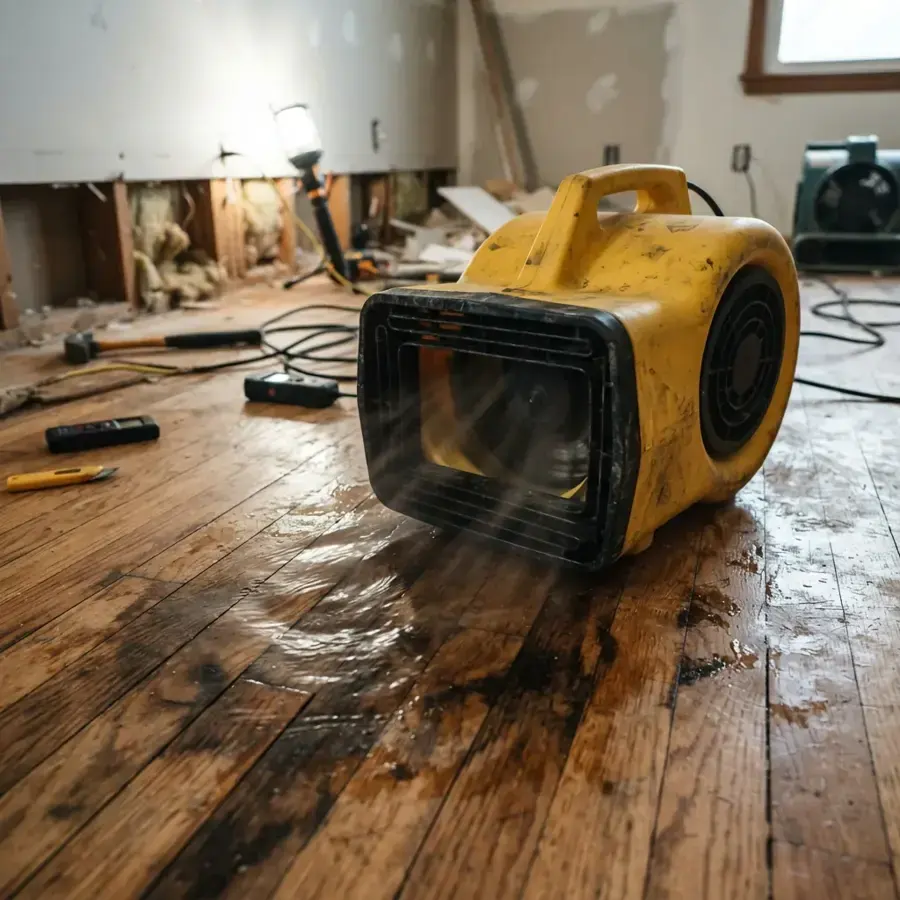
What to do the moment you find structural drying
- Take the surface water out
Machines cannot dry a building that still has water pooled on the floor.
- Keep windows closed
Humid air from outside in warm weather adds moisture back inside.
- Do not switch machines off at night
Overnight shutdowns stall the progress made during the day.
- Ask for a check
Have the crew read the building against a dry reference before rebuilding starts.
How structural drying is handled in Kannapolis
Measured against this home
The dry reference comes from an unaffected room in the same house, not from a generic chart, so the goal fits this building and its materials.
Old and new materials
Plaster, older framing, newer drywall and engineered flooring dry differently, so equipment is placed per material.
Cavities included
Wall bases and cavities behind cabinets get airflow too, so moisture is not sealed in behind finished surfaces.
Equipment released on proof
Machines are removed only after readings meet the goal, and the final numbers go to the homeowner and the insurer in writing.
What does structural drying and dehumidification cost in Kannapolis, NC?
Plan on $1,000 to $6,000 for structural drying in Kannapolis, NC. Price follows the loss class, the number of wet rooms, the materials involved and the days machines run, with hardwood and concrete costing more time.
Several fans, a single LGR dehumidifier, brief monitoring
$1,000 to $2,500Added machines, wall cavity drying, daily logs
$2,500 to $4,500Desiccant dehumidifiers, drying mats, long monitoring
$4,500 to $6,000+Every loss is priced on its own scope. Run the numbers in the water damage cost calculator for a planning range.
The structural drying and dehumidification process, start to dry
- 1
Map, then class
Wet materials are charted and the loss is assigned its S500 class.
- 2
Set the machines
Air movers and LGR dehumidifiers are placed, with desiccant units added for dense materials.
- 3
Monitor daily
Each visit logs temperature, humidity and material readings, and machines are moved to match.
- 4
Confirm the goal
Machines go home once each wet material reads within 2 to 4 points of dry framing.
Most of a water loss is invisible: the moisture sitting in framing and subfloor after the surface looks fine. Drywall faces dry in a day or two, yet studs, plates, subfloor and hardwood hold water far longer. Kannapolis homes range from 7,549 built before 1960 to 4,870 built from 2010 to 2019, and the materials inside them dry at very different rates.
How the S500 approach works
- A moisture map comes first, so machines go where the water really is
- The class, 1 through 4, reflects how much wet material a room holds and how porous it is, and sets the equipment count
- Air movers are positioned by each room's evaporation load
- Most losses use LGR dehumidifiers, while hardwood and concrete in Class 4 call for desiccant units
The drying goal
Machines leave when readings say so. The crew reads a dry sample material in an unaffected part of the same home, then measures the wet materials daily until they come within 2 to 4 points of it. Thin drywall arrives first, while hardwood, plaster, concrete and long-running leaks take longer, and no fixed day count applies.
Machines gone but the walls still feel damp? Call for a readings check against the goal.
Why the log matters for the claim
A day-by-day log of temperature, humidity and moisture content backs up the claim. Adjusters read it to confirm that the equipment and the time spent fit the loss, and the homeowner learns when repairs can truly begin. For water that must leave first, see water extraction, and try the drying-time estimator for a planning range.
Structural Drying and Dehumidification across Kannapolis, NC
The Kannapolis restoration crew covers the city's eight ZIP codes across Cabarrus and Rowan counties, including 28081, 28083 and 28082, from Laurel Park, Jackson Park and Forest Park to Rose Hill and Cannon Manor, and the main Huntersville water damage restoration page covers the wider region.
Related water damage services in Kannapolis
Structural Drying and Dehumidification questions in Kannapolis, answered
What does IICRC S500 actually cover?
It is the trade's written method for water losses: how to inspect, how to sort water into categories and classes and how to confirm drying. It turns the word dry into a number the whole team can check.
How do the four classes differ?
Classes describe how much water a space holds. Class 1 is little wet material, Class 2 is a whole room of carpet and wall, Class 3 is the heaviest, and Class 4 is deep moisture in dense materials like hardwood.
Are store-bought fans enough?
Fans move air but cannot pull moisture out of it. Without dehumidifiers the water just cycles into the air and back into materials, and nobody measures whether framing is dry.
How is a building proven dry?
Meters read the wet materials, and the numbers are set beside readings from a dry sample elsewhere in the home. Once they come within 2 to 4 points, the goal is met.
Will hardwood flooring recover?
Often, when work starts quickly. Drying mats coax moisture upward out of the boards and desiccant units handle dense planks, though badly cupped boards may need replacement.
How many days will drying take?
No fixed number applies. Drywall finishes before hardwood, plaster or concrete, and readings, not a calendar, decide when machines leave.
Structural Drying and Dehumidification in Kannapolis? Call now.
Standing water keeps wicking into drywall, subfloor and framing until it is pulled out. The restoration crew serving Kannapolis extracts it, dries the structure to the IICRC S500 standard and records every reading for the claim.
(888) 578-4720Get a Kannapolis drying crew movingHuntersville Water Damage Restoration
Kannapolis, NC
Dispatch open every hour, every day of the year
Find us on Google