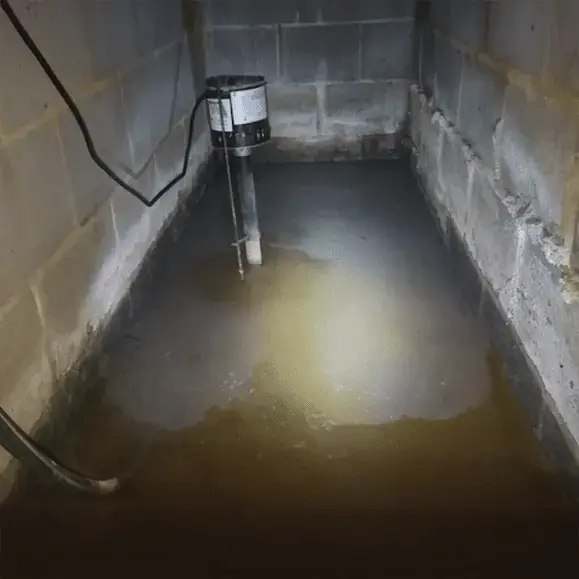
In Huntersville, a heavy rain does not always end when the sky clears. A lot of the water that fell on the yard is still working its way toward the foundation, and the space under the floor is where it tends to land.
Key takeaways
- Piedmont red clay drains slowly, so storm runoff sits against foundations and finds its way into vented crawl spaces.
- Water under the floor can come from rain, from a plumbing leak, or from both, and the first job is telling which.
- Shut off the water supply and the power to anything under the house before anyone goes in.
- Standing water is pumped out first, then insulation, vapor barrier and framing are checked and dried.
- Waiting for the crawl space to dry on its own leaves wet wood and insulation in place for weeks.
Why red clay sends water under Huntersville houses
Much of the ground around Huntersville is Piedmont red clay. Clay holds water and releases it slowly, so a downpour that a sandy yard would swallow instead runs across the surface.
That runoff sheds toward foundations. A house sits low relative to its own downspouts, patio and grade, and the water follows gravity to the lowest open space it can reach.
- Slow drainage: clay stays saturated long after the rain stops, so the soil along the foundation keeps pushing water inward.
- Intense bursts: summer thunderstorms in the area drop heavy rain in a short window, which overwhelms yard drainage faster than steady rain does.
- Multi day rain: the remnants of tropical systems, such as Florence in 2018 and Helene in 2024, soak the ground for days before the storm even peaks.
What the housing stock means for crawl spaces
Many Huntersville homes were built in the 1990s through the 2010s in subdivisions that grew along I-77, NC 73 and NC 115. A large share are two story homes on vented crawl spaces, while others sit on slabs.
A vented crawl space has openings in the foundation wall that let outside air move through. Those same openings let stormwater in when the ground outside is soaked.
Finished walk out basements on lake and creek lots are a different setup, and they have their own water paths.
Is it rain, a leak, or both?
Before anyone plans the cleanup, the source has to be identified. The fix for a plumbing leak and the fix for a runoff problem are different, and a crawl space can have both at once.
Signs the water came from outside
Water that appears after a storm and recedes over a few days usually came from the yard. It often shows up near the foundation wall that faces the slope.
- Mud or silt stains on the vapor barrier or the dirt floor.
- Water that entered near a vent opening or a corner of the foundation wall.
- A wet crawl space only after rain, with a dry plumbing run overhead.
Signs the water came from a pipe
A plumbing leak keeps feeding the space whether or not it has rained. The supply pipes, drain pipes and water heater connections above the crawl space are the usual suspects.
- Dripping from a pipe, joint or fitting overhead.
- Water that continues on a sunny day.
- A water meter that moves when every fixture in the house is off.
What to do in the first 24 hours
The first day sets how much of the structure gets wet. A few quick steps limit the spread and make the restoration work easier.
Safety comes first. Water under a house can sit near wiring, ductwork and a water heater, so nobody should crawl in while the power is on.
- Shut off the main water supply if a pipe may be leaking.
- Turn off the breaker for any outlet, light or equipment in the crawl space.
- Look at the ceiling and floors above for sagging, stains or soft spots without stepping into the water.
- Photograph the standing water, the vents and any wet insulation before anything is moved.
- Call the restoration team for water extraction rather than waiting for the space to dry unaided.
How the extraction crew works the space
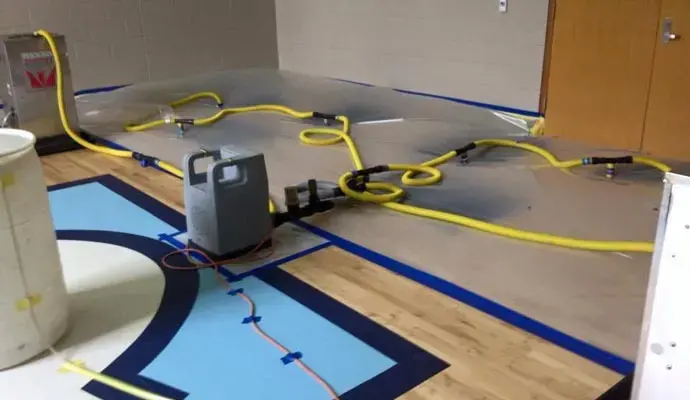
The first step is removing the standing water. A water extraction crew uses submersible and portable pumps sized to a crawl space, because truck mounted equipment cannot reach under a floor.
Once the pooled water is gone, the team checks what stayed wet. Insulation holds water like a sponge and can pull a floor system down if it is left in place.
- Insulation: wet batts hang loose, hold moisture against the subfloor and are usually removed.
- Vapor barrier: it is inspected, cleaned and either dried or replaced where it is torn.
- Framing and subfloor: joists and floor sheathing are measured with moisture meters before and during drying.
- Ductwork: low runs can take on water and need a look before the system is used again.
Drying a crawl space the right way
Pumping removes the water you can see. Drying removes the moisture in the wood, and that takes airflow and dehumidification set up for a tight space.
A crawl space water damage cleanup plan uses air movers and dehumidifiers placed through an access opening, with readings taken each visit. The drying is finished when the meters show the framing back at its normal range, not when the surface feels dry.
How long that takes depends on the material, the amount of water and the weather. The drying time estimator gives a rough picture before the crew confirms it with readings.
Why waiting makes it worse
A humid subtropical summer keeps outside air heavy with moisture, and a wet crawl space has nowhere to release it. Wood that stays damp can start to deteriorate, and mold can follow within days. That is why the first 48 hours matter.
The smell often reaches the living space before anyone sees a problem. Floors above can cup, buckle or feel soft long after the water below is gone.
- Subfloor and joists that stay wet lose strength over time.
- Insulation left in place keeps feeding moisture upward.
- Odors under the house tend to rise into the rooms above.
Checking your own risk before the next storm
Not every crawl space floods. Slope, gutters, downspout discharge and the condition of the vapor barrier all change the odds.
The red clay crawl space risk check walks through the common factors in a few minutes. It is a screening tool, not a verdict, but it helps a homeowner see where water is most likely to enter.
- Downspouts that end within a few feet of the foundation add water exactly where clay holds it.
- A grade that slopes toward the house instead of away sends runoff to the wall.
- Vent openings at ground level are the most common entry point for surface water.